


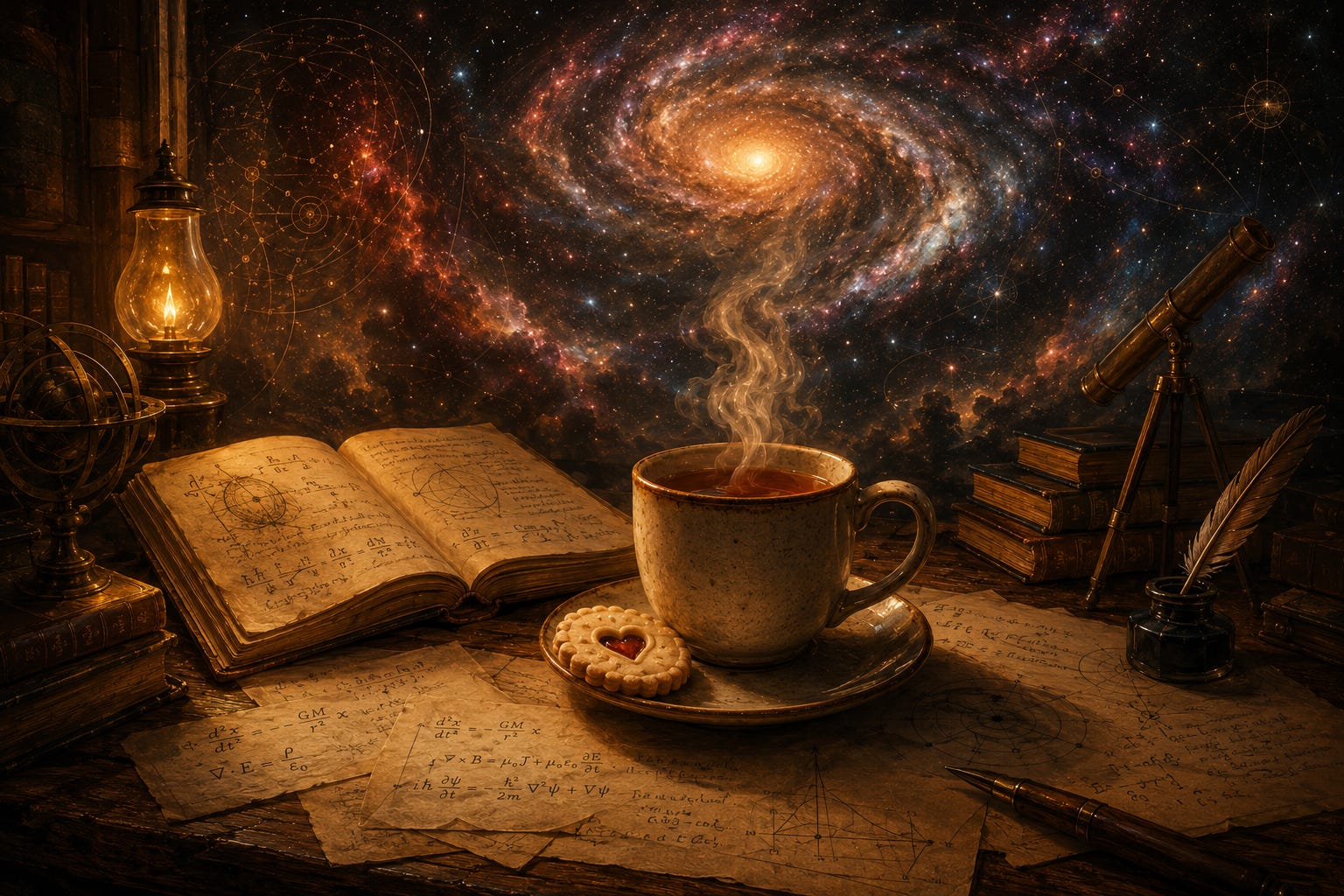
I am an avid tea drinker. I drink tea by the gallon and my wife jokes that when I die, rather than donate my body to medical research, she’ll offer my ashes to the Tetley Tea Company. I could quit chocolate; I could renounce ice cream; but it would take a miracle to persuade me to give up tea. And speaking of the miraculous, I think that the humble cup of tea contains a clue to understanding miracles.
There is a lot of confusion about miracles and a lot of nonsense talked about the miraculous. Not least, the common assumption that in the twenty-first century, in the age of computers, particle accelerators, and heated WiFi-enabled toilet seats, no sensible person can believe in things like miracles and the supernatural; rather they’re for the gullible, the religious, and the Bible-addled.
But what if I told you that the Bible doesn’t believe in the supernatural either?
“I thought you were a Christian philosopher!” I can hear some of you protest. To which I reply (after a swig of tea): “Indeed I am; and that’s precisely why I’m a little bit dubious about words like ‘supernatural’.”
What I mean is this: nowhere does the Bible teach that you can divide the world in two, into a ‘supernatural’ bit that God is responsible for and a ‘natural’ bit that more or less does its own thing. Rather the Bible explains that God sustains everything. Every atom, every particle, every law of physics only exists because God upholds it.
This is a much bigger view of God than many people (including many Christians) have ever stopped to consider. Plus if you are an atheist, it is also a little ironic, because if you want to lob God out of the window and insist that the only things that exist are molecules and matter, you’re missing the fact that those things are only here in the first place because God created them and gives them their continued existence. Saying “I reject God and the miraculous because of science” is a little like saying “I dismiss the existence of authors because of words, letters, and punctuation marks.”
In other words, far from science being independent of God, science is only possible because God is actively, deeply, and personally involved with the world, sustaining it and giving it existence moment by moment. This is actually quite obvious when you think about it because for all the talk about science being all-powerful and able to answer everything, science can’t even explain its own deepest foundations.
For example, consider the question: why is there something rather than nothing? When you have a universe full of stuff, science does a very good job explaining why that stuff behaves the way it does. But as to why stuff exists in the first place, science can say nothing at all. (Just as the rules of cricket can explain what’s happening when England triumphs over Australia,1 but the rules cannot explain the existence of the game of cricket itself).
Incidentally, this leads to another of those nice little ironies with which philosophy is littered. Namely that all of us have to believe in miracles, by which I mean things-that-science-alone-cannot-explain. If you are an atheist and want to believe that the universe came from nothing, you’re welcome to do so; but at least admit what you’re doing. You’ve simply substituted belief in things like the virgin birth of Jesus for belief in the virgin birth of the universe.
It seems that we cannot escape miracles—if by ‘miracle’ you mean something that the laws of physics cannot explain, whether that is the origin of the universe or something apparently far more mundane, like mathematics and why science can’t work without it.
Quite why maths and science fit so well together has long been a head-scratcher. The puzzle was most famously pointed out in 1960 by the Hungarian physicist Eugene Wigner, in an article called ‘The Unreasonable Effectiveness of Mathematics in the Natural Sciences’. In it, Wigner explores how remarkably odd it is that maths and physics fit together with such uncanny (and useful) precision.
Why is that odd? Well, if there is no God and mathematics is just a human creation, then numbers were merely something invented by Mesopotamian goat-herders sometime around the second millennium BC to keep track of their goats. So how on earth is it that numbers can describe the curvature of space-time or the behaviour of black holes? Either those goat-herders got really lucky, or something bigger is going on.
Where do we go with all of this? Well, maybe it is helpful to reflect that trying to play off ‘God’ and ‘science’ or ‘natural’ and ‘supernatural’ misses something very important, namely that there can be different levels of explanation. Which brings us back to where we started: with the humble cup of tea.
Sitting on my desk as I write is a steaming mug of English Breakfast tea. What is it doing here? A physicist might talk about how electrons and protons form atoms, from which all material things (including tea) are made. A chemist might use little plastic balls to model how molecules work, or explain the Brownian Motion of the particles in my cup whilst a biologist might opine about the evolutionary history of the tea plant. All those are good (if slightly nerdy) answers to the question “Why is this tea here?”
But what if you simply asked me? In which case, I’d look at you, laugh, and say “the tea exists because I need something to dunk my Jammie Dodger biscuit2 into as part of my mid-morning snack”.
Does my explanation contradict those of the scientists? No, it’s just a different level of explanation and it illustrates something very important: that there are scientific explanations but there are also personal explanations. The laws of science tell us what will happen unless somebody personally intervenes: drop a ball, and it will fall in accordance with Newton’s Second Law of Motion. But reach out your hand and catch the ball and that law no longer applies. You have personally intervened in the universe.
So now the question arises: if humans can intervene and act personally in the world, what about God? Clearly if God exists, he can. So perhaps the question isn’t can he, but has he? And this is where Christianity is fascinating because the whole Christian faith is founded on the historical claim that God intervened at one point in history in particular—in the life, death, and resurrection of Jesus (for which there is tremendous historical evidence).
But if God can (and has) acted in history, that raises the next and more important question: what are you going to do about it? As I often remind my sceptical friends, miracles can do many things, but they can’t prevent somebody refusing to consider the evidence. Why not start with a fresh cup of tea and an honest look at the Gospels and their story of the life, death—and resurrection—of Jesus.
If you found this piece helpful, thought-provoking, curiosity-sparking or in other ways useful, please do consider subscribing. It helps me keep my writing free for those who can’t afford to make a contribution.
Some might say that England beating Australia is one definition of a miracle.
One of the strokes of genius of British invention, up there with the steam engine, the Thermos flask and television, a Jammie Dodger consists of two layers of biscuit, glued together with a combination of cream and jam. Everybody gets excited about composite materials in aviation—we British have had them in biscuits since the 1960s.
Hi Andy,
Thank you for this piece. I enjoyed it and your writing style a lot.
You might remember me - you liked a comment I made on Paul K's latest piece. I am a baby believer (about 6 months old), and am so grateful to have found God. Pretty much all I want to do is be with Him in prayer, read scripture, be in fellowship, and write about it all, including the story of my conversion.
So, as a baby believer, I have a question about something you wrote but don't quite follow. You said: "What I mean is this: nowhere does the Bible teach that you can divide the world in two, into a ‘supernatural’ bit that God is responsible for and a ‘natural’ bit that more or less does its own thing. Rather the Bible explains that God sustains everything. Every atom, every particle, every law of physics only exists because God upholds it."
I know that God sustains everything. But aren't there things He does that happen that we can't explain, that we might call supernatural? And following on from that, then maybe the things He does that we can explain, that we might call natural?
Warmly,
Heike