

Based on a talk first given at Canford School in Dorset
I was recently stunned when I logged onto the BBC News website to read the following story:
In a stunning historical revelation, researchers at the German Federal Archives have uncovered a handwritten letter, allegedly dictated by Adolf Hitler on April 29, 1945—just one day before his death. The letter, addressed to an unnamed clergyman, contains statements of remorse, with Hitler reportedly confessing his “immeasurable guilt” and pleading for God’s mercy. “I was blind,” one passage reads. “If there is a God, may He have mercy on my soul.” Historians are divided on the letter’s authenticity, but if genuine, it could rewrite everything we thought we knew about one of history’s most infamous figures.
How does that story make you feel? Shocked? Relieved? Outraged? Baffled? Stunned? Why is that? I confess I made that story up. (And when I gave a talk at a school based on this essay, I even photoshopped the BBC News website and had half the students in the room convinced).

But suppose the story were true. Could God forgive Hitler?
Evil incarnate?
One of the grim realities of human nature is that we are very conflicted creatures. All of us have the ability to be angelic and all of us have the ability to be monstrous. If only one could easily divide the world into “totally good” and “totally evil” people, life would be so much easier, right?
But Hitler does seem easy to categorise. He is one of a small group of people (Stalin might be another) whose actions represent the utter extremes of human wickedness. Hitler was responsible for the death of six million Jews in the Holocaust, along with millions of others—prisoners of war, Roma gypsies, civilians, the list goes on.
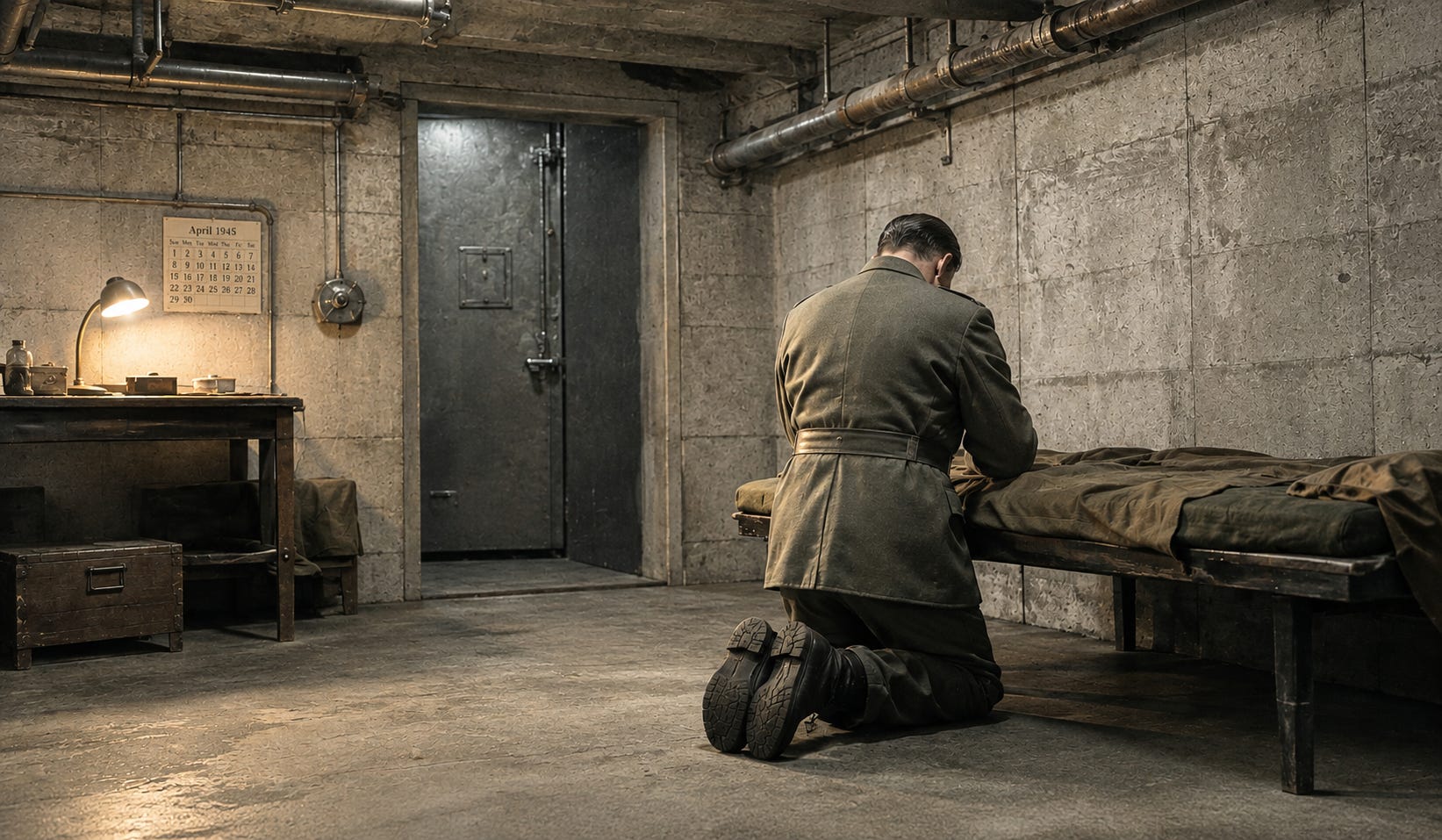
No wonder that if historians did discover that on 29 April 1945, as Allied troops were closing in on the Führerbunker in Berlin, Hitler had somehow prayed, repented and come to Christ, we’d be asking: could God forgive Hitler? Would Hitler be in heaven?
Some thoughts about forgiveness
What amazing questions. But to tackle them honestly and properly, we first need to explore a little bit of background, starting with asking what we mean by forgiveness and why we need it in the first place.
At the heart of the Christian faith stands the incredible claim that Jesus died on a cross to forgive our wrongdoing, our brokenness, our screw ups, our evil. As Jesus himself put it:
For even the Son of Man [Jesus’s preferred title for himself] did not come to be served, but to serve, and to give his life as a ransom for many. (Mark 10:45)
But maybe your reaction to that is “Well, I don’t need forgiveness. There’s nothing wrong with me.” Well, nice try: but the reality is we all go wrong in all kinds of ways.
Imagine that you died and arrived in heaven. An angel meets you at the gates of heaven and says, “Welcome, so glad you could make it, we’ve arranged a special surprise for you”. And he escorts you to what appears to be a cinema. He guides you to screen 1, sits you down alone, and gives you a large bucket of popcorn. “Welcome to the Theatre of Judgement” says the angel, smiles, then disappears as a movie begins to play.
Lo and behold, it’s the movie of your life—everything you’ve ever thought, said, or done is up there on the screen. Some bits are great, other bits make you cringe with embarrassment—all the stupid decisions, all the rude hurtful things you said about others, all those secret thoughts and selfish ambitions. All the things you did—but also the things you didn’t do.
Finally the movie ends and as the credits roll, the angel reappears. “Hope you enjoyed that,” he says cheerfully. “Now we’re going to have a second screening, and everybody else featured in the movie is going to come and watch it—all your family, your friends, your enemies, your neighbours, colleagues—everybody is going to get to watch every little detail of your life”.
Who would want that? Who would want to show that movie to their friends, family, to their dear old granny? Most of us who are really honest with ourselves know there are things deep within us that we don’t want anyone to know about—and the Bible has a word for that stuff, for that inner brokenness we try to hide from others, even ourselves. The Bible calls it “sin”.
Imagine that you commit 5 sins a day, every day, between the age of 16 and the age of 60. Nothing necessarily major, just petty cruelties. That’s a total of 80,355. And that’s before we get to things you should have done, but didn’t. Friends you could have helped. That mobile phone you bought despite knowing it was made by slave labour in China. And so on. That life movie is looking more like a multi-part series now and granny is in for a massive shock.
No wonder that the Bible says:
“For all have sinned and fall short of the glory of God” (Romans 3:23)
Every one of us needs forgiveness. No exceptions.
But suppose you say, grudgingly, okay, maybe I might need forgiveness. Well why can’t God justforgive me; why did Jesus have to die?
Well, notice something for a moment. Real forgiveness, genuine forgiveness is always costly. Imagine that you were to accidentally reverse your car into mine and dent it, causing £1,000 of damage. You look in the glove compartment for your paperwork and horrified, you discover your insurance has expired—and there’s no way you can afford to pay for this yourself. But I take pity on you, forgive you your debt and let you off—you have been forgiven but your forgiveness came at a cost. I paid the price so you could be forgiven. Your forgiveness was not free.
Or imagine a friend betrays you and damages your reputation. Then they come to you, genuinely ask for your forgiveness and you forgive them. But forgiveness carries a price. If you choose to forgive them, you have to carry within you the cost of forgiving them and turning away from vengeance.
Forgiveness is always costly for the forgiver and always free for the one being forgiven. And thus it’s no surprise that this even more the case when it comes to God. Because the reality is that each one of us is so bad that Jesus had to die for us, yet so loved that he was glad to die for us. As the Bible puts it:
God demonstrates his own love for us in this—while we were still sinners, Christ died for us. (Romans 5:8)
But here’s the thing—if forgiveness is free, where is justice? If you’re feeling that tension, good—because it shows you understand something crucial: forgiveness isn’t the absence of justice. True forgiveness is costly. Someone has to bear the weight of the wrongs done. That’s exactly why God didn’t just wave sin away, but Jesus paid for it with his own life.” Grace isn’t cheap. It’s incredibly expensive. God doesn’t just shrug his shoulders at sin. Every sin (yours, mine, Hitler’s) is accounted for. Either we bear it ourselves, or Jesus bears it for us. There is no third option.
So … what about Hitler?
And that we all need forgiveness and that forgiveness is costly is the key to thinking about Hitler. Because here is the thing: if you discovered that Hitler really had repented and would enjoy an eternity with God, your response reveals nothing about God, nor about Hitler, but it reveals a lot about you.
You see here’s the question: what grounds or basis do you have for getting into eternity that Hitler didn’t have? Why should God allow you into heaven? Maybe you might say:
· “I’ve done more good works than Hitler!”. But good works are not the basis of God’s forgiveness.
· “I’ve lived a better life!”. But that’s not the basis of God forgiving you.
· “I didn’t do the evil that Hitler did!”. But if you’re a Christian, this is not why God forgave you. God does not owe you, or me, or any of us forgiveness. Forgiveness by its very nature is always free to the one receiving it.
So why would God forgive you? Because you genuinely asked. And genuinely repented. And genuinely threw yourself on God’s mercy. And when God forgives you, you did not deserve it. Not in the slightest. It was totally God’s gift.
Apart from God’s grace, we would end up separated from him for eternity. And we would entirely deserve it. But if you ask God’s forgiveness and receive it and get to spend eternity with him, there will never—not for one single second in eternity—be a moment where you deserve to be there.
And so ends our thought experiment.
Let’s be clear, I don’t think there is the slightest piece of evidence that Hitler repented because forgiveness needs true repentance. But God could have forgiven him. But let’s forget Hitler for a moment. Let’s talk instead about you. You see, if God’s grace is big enough for Hitler, it’s big enough for you and your mess ups. But have you accepted it?
Practical Forgiveness
And all of this isn’t just theoretical, but it is also very practical. Because God’s forgiveness also has an impact in the real world, bringing peace between those who were once enemies.
One of my heroes is Corrie ten Boom. In 1939, Corrie lived with her father and sister in the Netherlands, where her father ran a watchmaker’s shop. Holland fell to the Nazis in 1940 and soon attacks on Jews became commonplace. Committed Christians, Corrie and her family began helping to smuggle Jews out of the country, hiding many in their home. But in 1944, disaster struck. They were discovered and the family were arrested by the Germans. Her father died very quickly, but Corrie and her sister, Betsie, were shipped to Ravensbrück Concentration Camp. There they suffered terrible abuse and atrocities and Betsie eventually died an agonising death.
Corrie, however, survived and was eventually released and began a post-war career as an evangelist, speaking about God’s love. But one day, something shocking happened. Let me quote Corrie’s own words:
“It was at a church service in Munich that I saw him, the former SS man who had stood guard at the shower room door in the processing centre at Ravensbrück. He was the first of our actual jailers that I had seen since that time. And suddenly it was all there—the roomful of mocking men, the heaps of clothing, Betsie’s pain-blanched face.
He came up to me as the church was emptying, beaming and bowing. “How grateful I am for your message, Fräulein”, he said. “To think that, as you say, He has washed my sins away!”
His hand was thrust out to shake mine. I tried to smile, I struggled to raise my hand. I could not. I felt nothing, not the slightest spark of warmth or charity. And so again I breathed a silent prayer. Jesus, I cannot forgive him. Give me Your Forgiveness.
As I took his hand the most incredible thing happened. From my shoulder along my arm and through my hand a current seemed to pass from me to him, while into my heart sprang a love for this stranger that almost overwhelmed me.
And so I discovered that it is not on our forgiveness any more than on our goodness that the world’s healing hinges, but on Christ’s.”1
I think Corrie was right. And if that is true, that God’s forgiveness does not hang on us but on Jesus, then yes, God could forgive even the most monstrous of us. He has forgiven me (and I know what I can be like and how much I needed it). So what about you?
Corrie ten Boom, with John and Elizabeth Sherrill, The Hiding Place (London: Hodder & Stoughton, 1971) pp.215-216.