



Many Western countries are now very pluralistic, with many of our major cities incredibly culturally and religiously diverse. That religious diversity is growing rapidly and is especially apparent when it comes to Islam: the number of Muslims in the UK is currently at 4 million (6%) and could potentially rise to around 13 million (17%) in 25 years’ time.1
To deal with that diversity, many Western cultures try to champion the idea that all the world’s religions are essentially the same. For example, when comparative religion is taught in places like schools, it’s often done in a way that implies the world’s major faiths are virtually identical, just the names are changed: e.g. Muslims go to mosque, Christians go to church; Muslims have the Qur’an, Christians have the Bible; Muslims follow Muhammad, Christians follow Jesus.
The assumption is that all religious people are talking about the same thing, just in different ways.
Enter the Elephant
There’s a 2,500-year-old Indian folk tale that’s often told to illustrate this very point. It tells how four blind men were shown into a room in which there was an elephant. The first blind man grabbed hold of the tail. “Aha! An elephant is like a rope,” he declared. The second blind man hugged the elephant’s leg. “No, you’re wrong,” he retorted, “an elephant is like a tree.” The third blind man felt the elephant’s trunk and laughed: “You two are mad! The elephant is more like a snake.” The fourth blind man stumbled into the side of the mighty beast: “You’re all wrong,” he chuckled. “An elephant is actually like a wall.”
You get the idea of the story. Each blind man was right in his own way; each had a small grasp on the truth. However, their mistake was assuming they were right and their friends wrong: instead, everybody was right. In the same way, it is sometimes suggested, religions are perhaps like this. Each religion has a small grasp on an aspect of what God is like—and if only they could recognise they only had part of the truth, then there would be peace and tolerance.
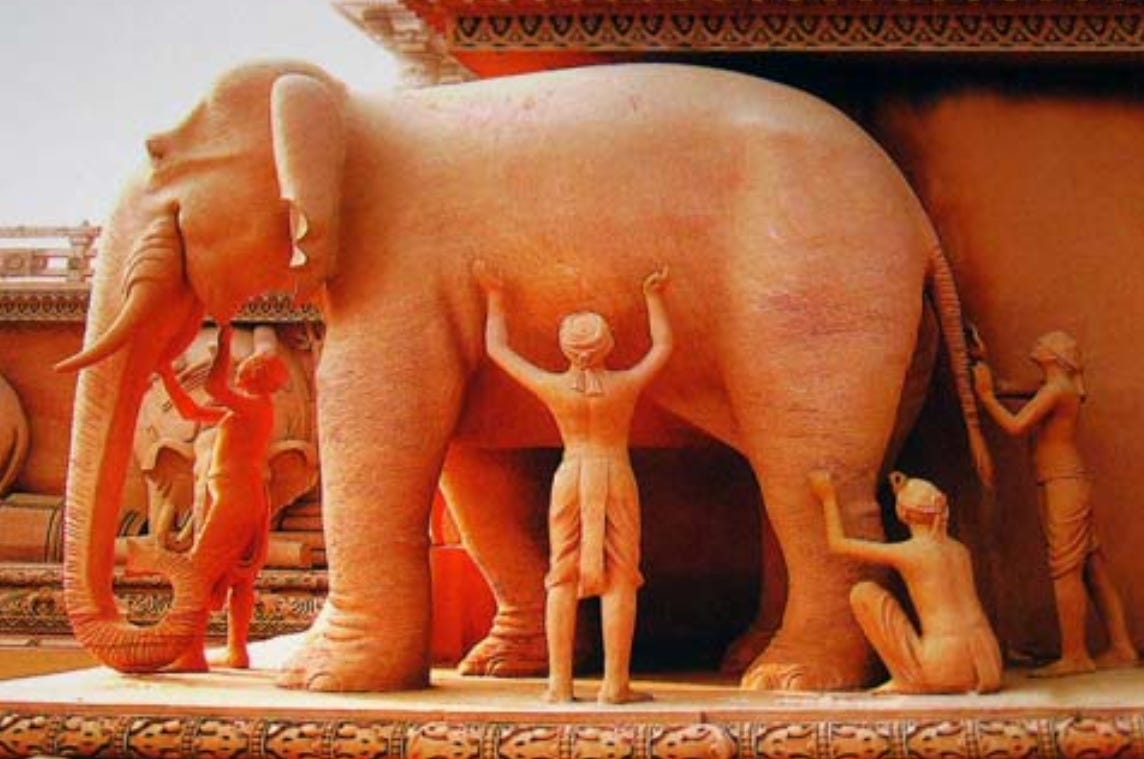
But there are several problems with the story. First, it assumes the thing it wants to prove, namely that everybody is talking about the same thing. Retell the story and have each blind man feeling his way around a different animal, and the parable collapses.
But even more tricky than that, consider this. Who is the most arrogant person in the story? It’s not any of the blind men. It’s the person telling the story. By my very telling of the story, I’m claiming that only I can see the whole picture and that everybody else in the story is blind. The irony is astonishing: a story often told to illustrate the arrogance of exclusive religious truth claims turns out to be the utter height of arrogance itself.
The Problem with Words
I think a lot of the confusion in this area that’s led people to suggest the world’s religions are similar has been caused by the fact that people use the same words in different ways. It’s thus assumed that when Muslims talk about “god” and Christians talk about “god”, we mean the same thing by that word.
I lived for six years in Canada and that taught me that words do not always mean the same thing for different people. For example, to my Canadian friends, “pants” means not underwear, but trousers—a fact that caused a lot of confusion. I remember our immigration lawyer saying to us as we entered his office, “Forgive me for not standing up to greet you, but I’m not wearing pants today”—by which we later discovered he meant he was wearing tennis shorts.
Likewise, when Muslims and Christians say they believe in “one god”, we need to stop and listen carefully, not assume “Aha! This means the same thing.” After all, if I say I believe in one British Prime Minister and it’s Keir Starmer, and my friend Sam says he believes in one Prime Minister and it’s Mickey Mouse, we clearly both believe in one Prime Minister, but we differ about their identity.
Or if we spoke to a Marxist and a Capitalist and asked them: “Do you believe in economics?” and both said “Yes”, we’d be mistaken if we said “Marxism and Capitalism are the same” on that basis.
The Bible, the Qur’an, and God
A few years ago I decided to do a piece of research to explore this more deeply and I later wrote a book based on that work. I thought it would be interesting to compare what the Bible and the Qur’an have to say about the nature of God. Sure, both the Christian scriptures and the Muslim scriptures assume there is one God. But what is that God like?
I was very surprised to discover some huge differences. There are four major characteristics of God according to the Bible and those characteristics are either ignored, or outright contradicted by the Qur’an, which has a very different understanding of God.
Let’s explore them briefly one by one.
God is Relational
The first characteristic of God in the Bible is that God is relational. This is the thrust of the whole story of the Bible, from the opening pages to the very last chapter. In the opening chapters of Genesis, we read of how God was to be found, walking and talking in the garden with Adam and Eve. God walks and talks with Abraham (Genesis 17-18), speaks to Moses face to face “as a man speaks with his friend” (Exodus 33:11), and, indeed God speaks with his people throughout the Old Testament. In the New Testament, God steps into history in the person of Jesus. And, at the close of the Bible, we are told that in heaven, the age to come:
The dwelling of God will be with men, and he will live with them. They will be his people and God himself will be with them and be their God. He will wipe every tear from their eyes. There will be no more death or mourning or crying or pain, for the old order of things has passed away. (Revelation 21:3-4)
The Bible uses highly relational language to describe God. He is described as a father, as a friend. He is the relational God—and the Bible’s call is for people to be in relationship with him.
For the Qur’an, on the other hand, there is no such relationship to be had with Allah. Allah, the god of the Qur’an, is distant and transcendent—and nowhere does the Qur’an invite its readers to enter into a relationship with him. According to the Qur’an, Allah did not walk and talk in the garden with Adam and Eve. He is not present with his people in heaven. And he did not take on flesh in the person of Jesus. The only “relationship” that exists between humans and Allah according to the Qur’an is that of master and servant—certainly not Father.
Indeed, in the Qur’an, in Sura 112, once described by Muhammad as so significant that reciting it is equivalent to reciting a third of the Qur’an, the Qur’an strongly declares that Allah is not a father and that Allah has no son:
He (Allah) has not begotten, and has not been begotten. (Q. 112:3)
Summarising this crucial difference from the Bible, the influential Muslim philosopher, Shabbir Akhtar, wrote:
Muslims do not see God as their father … Men are servants of a just master; they cannot, in orthodox Islam, typically attain any greater degree of intimacy with their creator.2
God Can Be Known
The second major characteristic of God in the Bible is that God can be known. This flows in some way out of God’s relationality, because it’s only possible to have a relationship with somebody if they are willing to make themselves known.
If a new person moves into the house next door to yours and being a friendly person, you decide you’d like to get to know them. However, it turns out they’re incredibly shy: they work from home, order their groceries online, never come out of their house, keep their curtains drawn and never answer the door—well, any kind of relationship would be impossible because they refuse to make themselves known.
And the same is true of God. According to the Bible, God is a God who makes himself known. From beginning to end, the Bible tells the story of a God who reveals not just his commands but his character, his very self. For example, in Exodus 3, in the story of the burning bush, God speaks personally with Moses, revealing his personal name—Yahweh, “I am”. Ultimately the biblical theme of God revealing himself is seen in the person of Jesus, who tells his disciples in John 14:9 that “anyone who has seen me has seen the Father”.
Again, this is utterly different from how the Qur’an describes Allah, who does not reveal himself in this way or allow himself to be known personally—nowhere does the Qur’an ever invite its readers to know Allah.
Indeed, it’s remarkable how in qur’anic theology, even Muhammad did not have Allah reveal the Qur’an to him personally, but through an intermediary—the angel Gabriel. A huge contrast with the Bible, where time and time again, God speaks with his prophets and his people face to face, such as the powerful encounter that Moses has at the burning bush or on Mt. Sinai.
Listen to Muslim scholar Isma’il al-Furuqi unpack this:
Allah does not reveal Himself to anyone in any way. Allah reveals only his will … Allah does not reveal himself to anyone … that is the great difference between Christianity and Islam.3
God is Love
The third major characteristic of God according to the Bible is that God is a God of love. The Bible is very clear that one of God’s primary characteristics is love. The theme of God’s love is summed up in the amazing verse in 1 John 4:16—“God is love”. Love is not something the God of the Bible does, but something he is. Indeed, Christians love and serve a God who is Trinity—Father, Son, and Holy Spirit—and so at the heart of who God is lies a loving relationship.
When we turn to the Qur’an and its depiction of God, we see something very different. Nowhere are we told that Allah is love—indeed, because he is not triune, it would be impossible for him to be loving unless he first created something to love.
For unlike the Bible, the Qur’an is very reticent about talking of Allah and love. In fact the main Arabic word for love, aḥabba, is used with Allah as the subject of the verb just 42 times and of those occurrences, 23 are negative,4 the Qur’an describing the kind of people Allah does not love. For example:
Allah loves not the unbelievers. (Q. 3:32)
Allah loves not the prodigal. (Q. 6:141)5
The other 19 occurrences are conditional,6 the Qur’an describing the behaviour required to earn Allah’s love:
Surely God loves the doers of good. (Q. 3:148)
God loves those who fight in His way, (drawn up) in lines (for battle) as if they were a solid building. (Q. 61:4)
The Qur’an simply has no conception of Allah offering anything remotely like an unconditional love to humanity. As the Pakistani scholar, Daud Rahbar bluntly put it:
[T]here is not a single verse in the Qur’an that speaks of God’s unconditional love for mankind … [Its verses] do not say that God loves all men.7
God has Suffered
And finally to the fourth characteristic of God according to the Bible, namely that God has suffered.
One of the crucial things about love is that it cannot simply be spoken about; rather it must be demonstrated. Love needs to be shown in action, not just verbalised, not least because a major aspect of genuine love is that it is costly. If you truly love another person, you are willing to give of yourself to help them; and if they are hurting, you will grieve and suffer when they suffer.
And the love of the God of the Bible is demonstrated in what he has done to deal with the sin and shame that separate us from him. The Bible tells us that God grieves for his people, grieves over their sin, rebellion and unfaithfulness. And that ultimately, through Jesus and the cross, God paid the price to deal with our brokenness—as Isaiah 53:4 tells us, God “took up our pain and carried our sorrows”.
This is quite different from the Qur’an’s understanding of God. The god of the Qur’an is not a god who suffers—Allah feels no grief as a result of our sins or pain or suffering. Allah in the Qur’an certainly gets angry at sin; and that anger is expressed in wrath and judgment. But there is no heart response and nothing done by the qur’anic god to deal with the problem of sin. As Muslim theologian, Muhammad-al-Burkawi puts it:
Allah can annihilate the universe if it seems good to Him and recreate it in an instant. He receives neither profit nor loss from whatever happens. If all infidels became believers and all the wicked pious He would gain nothing. And if all believers became infidels it would not cause Him loss.8
Indeed, according to qur’anic theology, everybody must carry the weight of their own sin, hoping that on the day of judgement their good deeds outweigh their bad. As the Qur’an puts it in Surah 17:15:
No bearer of sin can bear the sin of another.9
… although fascinatingly, this hints at the idea that maybe a sinless one could bear another’s sins. In Christianity and in Jesus, whom both Muslims and Christians affirm as sinless, Christians believe that has happened.
The Heart of the Difference
As we have looked at the Bible, the Qur’an, and what Muslim theologians have to say, we have seen that there are some big differences between Islam and Christianity on this most important of questions: what is God like?
As the Australian linguist and qur’anic scholar, Mark Durie, writes:
Once we stray beyond what is implied straightforwardly from the idea of one all-powerful creator God, the Qur’an and the Bible diverge considerably.10
The Bible and the Qur’an have radically different views of the nature, character, and identity of God and those differences make a difference. Trying to ignore or paper over them risks grossly misrepresenting both the Qur’an and the Bible.
Living with Differences
But if there are major differences between the world’s major faiths, doesn’t that have implications for how we relate well together? I think it’s this fear that drives silly stories like the blind men and the elephant: some people assume that if we don’t all believe the same thing, we can’t build communities or societies.
But that’s clearly wrong. It’s surely possible to be friends with people and disagree over things (I’ve had many Muslim friends over the years as I’ve worked in academia). Or on a lighter note, I’ve been married to my wife for 25 years and we still disagree about many things: our marriage is all the stronger for us having strong views that don’t always align.
What we need to do—as individuals and societies—is learn to disagree well. Our schools and workplaces claim to really value diversity: so let’s lean into that and enjoy the fact we don’t all think the same. As the African theologian Lamin Sanneh, one of my favourite writers, put it:
[People are] often confused by the view that difference is threatening, fanatical, harmful, and negative while uniform agreement is sound, inclusive, and enlightened. If that were true, we would all be condemned to sameness, uniformity, and conformity.11
And let’s learn to listen well and to ask good questions. Four questions I’ve long found helpful for discussing and bringing out differences (and similarities) in beliefs are:
Do you think there’s a God and if so, what is God like?
What do you think human beings are?
What’s gone wrong with the world?
What’s the solution?
And lastly, don’t be afraid to examine the evidence—and to examine your own beliefs critically and be willing to explore those of others. Ultimately that’s why I’m a Christian, despite having studied Islam in depth for 25 years and taught academic philosophy and looked hard at atheism. It’s been a long journey wading through the evidence—but for me, I’m convinced where it points.
After all, as the great philosopher Socrates himself is reported to have said: the unexamined life is not worth living. That’s true of the religious life as much as the secular one.
If you found this piece helpful, thought-provoking, curiosity-sparking or in other ways useful, please consider becoming a paid subscriber. It helps me keep my writing free for those who can’t afford to make a contribution. Thank you.
And if you become a paid subscriber (or already are)—and would like a free ebook version of my full book on this subject, Do Muslims and Christians Worship the Same God? (this essay was based on one chapter), drop me a message in Substack and I’ll send you a copy as a thank you for financially supporting my work.

Source: ‘Europe’s Growing Muslim Population’, Pew Research, 29 November 2017, https://www.pewresearch.org/religion/2017/11/29/europes-growing-muslim-population/.
Shabbir Akhtar, A Faith for All Seasons (Chicago: Ivan R. Dee, 1990) p.180.
Isma’il Al-Faruqi, Christian Mission and Islamic Da’wah: Proceedings of the Chambésy Dialogue Consultation (Leicester: The Islamic Foundation, 1982) pp. 47-48.
See Q. 2:190, 205, 276; 3:32, 57, 140; 4:36, 107, 148; 5:64, 87; 6:141; 7:31, 55; 8:58; 16:23; 22:38; 28:76-77; 30:45; 31:18; 42:40; 57:23.
As Gordon Nickel points out, this is a striking contrast with Jesus’s famous story in Luke 15:11-31, where the father (representing God) shows incredible love and forgiveness toward his prodigal son. See Gordon Nickel, ‘The Language of Love in Qur’ān and Gospel’ in Juan Pedro Monferrer-Sala & Angel Urban, eds., Sacred Text: Explorations in Lexicography (Frankfurt: Peter Lang, 2009) 223-248, citing p. 229.
See Q. 2:195, 222 (twice); 3:31, 76, 134, 146, 148, 159; 5:13, 42, 54, 93; 9:4, 7, 108; 49:9; 60:8; 61:4.
Daud Rahbar, God of Justice: A Study in the Ethical Doctrine of the Qur’an (Leiden: Brill, 1960) p. 225.
Muhammad al-Burkawi cited in Samuel M. Zwemer, The Moslem Doctrine of God: An Essay of the Character and Attributes of Allah According to the Koran and Orthodox Tradition (New York: American Tract Society, 1905) p. 56.
See also Q. 6:164; Q. 35:18; Q. 39:7; Q. 53:38.
Mark Durie, The Qur’an and Its Biblical Reflexes: Investigations into the Genesis of a Religion (Lanham, MA: Lexington Books, 2018) p. 119.
Lamin Sanneh, Whose Religion is Christianity?: The Gospel Beyond the West (Grand Rapids: Wm. B. Eerdmans, 2003) p. 6.
Thank you for this, very helpful