


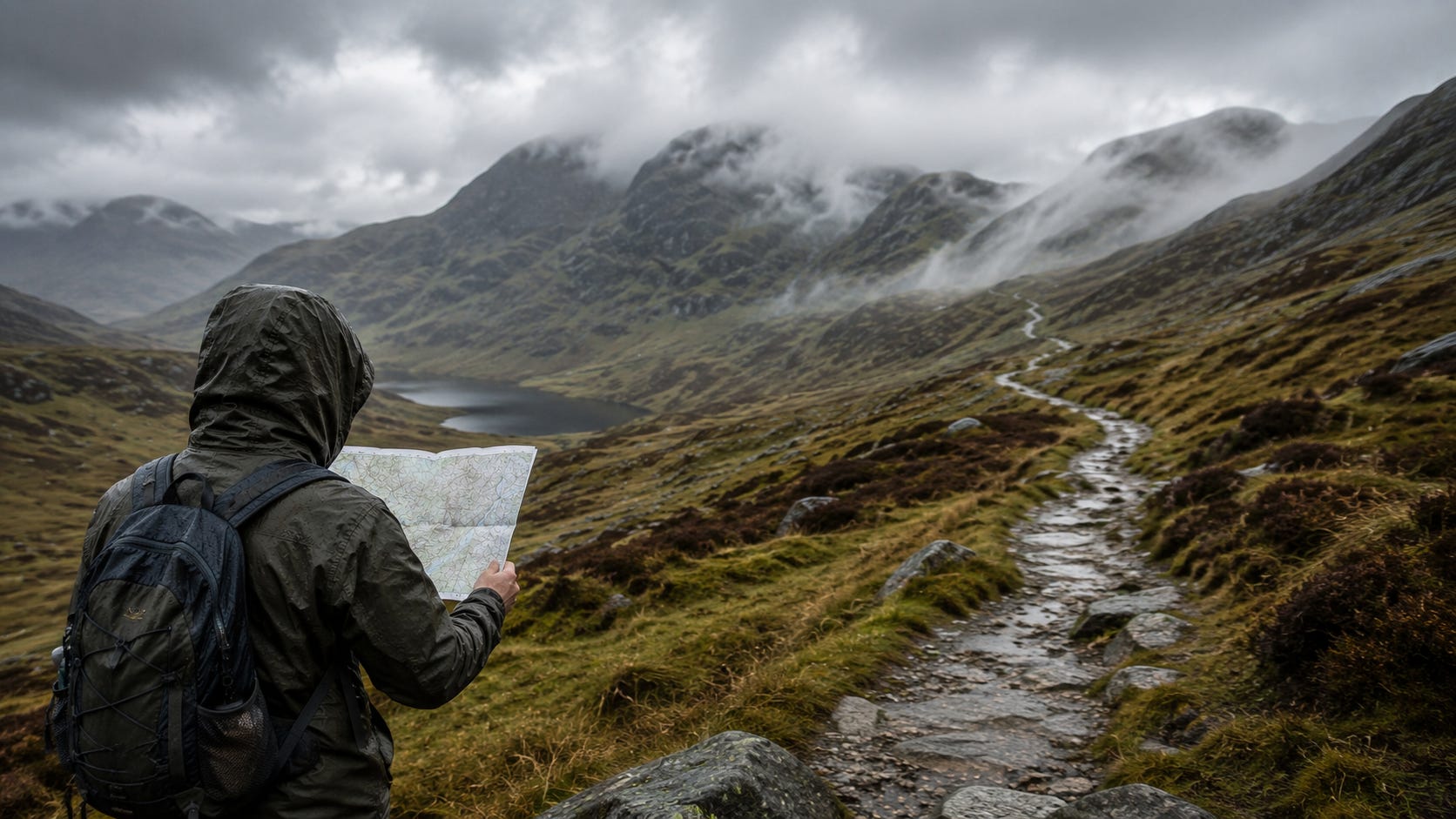
“This clearly isn’t a path,” my wife shouted, struggling to make her voice heard above the roar of the gale. We were on the side of a hill in the Lake District, enjoying what was supposed to be a summer afternoon stroll. But this being England, the weather wasn’t playing ball, or indeed any sport other than possibly water polo.
“But there’s a path marked on the map,” I protested, as the rain (which was blowing sideways) began to leak down my neck. Thankfully I was wearing one of those modern outdoor jackets optimistically marketed as ‘breathable’, which I think translates into “it lets the water in, but doesn’t let it out again”.
“What precise map are you using?” my wife yelled, as a raven blew past us, backwards.
“The OS one.”
“That explains everything.”
For those not familiar with British cartography, OS stands for ‘Ordnance Survey’, the UK national mapping agency. Its curious name reflects its roots, which lie in military history and defence of the realm. In the past, military surveyors would pace the land, mapping every peak and dale, every road and every village.
These days, things have changed. Much of the work of map making happens behind a desk, because using satellite photos and aerial photography is much cheaper. Unfortunately, it’s also less accurate, as cartographers can misread a photograph or simply come over all creative and say ‘Hey, let’s draw just a path here on the side of Mungrisdale Common and hope for the best’.
So I was fascinated recently to meet a lady out in the wild and lonely back country behind Skiddaw in the Lake District’s northern fells. What stood out was that she was carrying a backpack with a huge aerial sticking out of the top as well as some kind of electronic pole that she was tapping on the ground every 30 seconds or so. We fell into conversation and I asked her what she was doing.
“Ground-truthing,” she replied.
My experience of the terminology of modern surveying being on a par with my terminology of Latvian Spoon Dancing, I asked: “What’s ground-truthing?”
She explained her job was to walk all the major paths on the OS maps in the area, checking that what was on the map corresponded to reality.
“Sometimes I think somebody at a desk in Southampton makes a lot of stuff up,” she whispered conspiratorially. Then with a smile, she did something technical with her survey pole, and strode off purposefully northward.
But her word stuck with me. Ground-truthing. What a wonderful term. And what a crucial idea, that a hunch (drawn from an aerial photo, say) must be verified in person, on the ground. Cartographical theory needs testing against geographical reality.
WHEN PHILOSOPHY WANDERS OFF THE MAP
It also occurred to me that ground-truthing applies in lots of areas of life, for example when it comes to our deepest beliefs about the world. It’s very easy to come up with all kinds of clever ideas about life, the universe, and everything which sound great on paper or in your head, but then fail in the real world. I would suggest that atheism can be particularly prone to this.
Consider these words from atheist philosopher Alex Rosenberg, whose book The Atheist’s Guide to Reality is refreshingly direct about what atheism entails:
Is there a God? No.
What is the nature of reality? What physics says it is.
What is the purpose of the universe? There is none.
What is the meaning of life? Ditto.
Why am I here? Just dumb luck.
Is there free will? Not a chance!
What is the difference between right and wrong, good and bad? There is no moral difference between them.
Is abortion, euthanasia, suicide, paying taxes, foreign aid, or anything else you don’t like forbidden, permissible, or sometimes obligatory? Anything goes.
Does history have any meaning or purpose? It’s full of sound and fury, but signifies nothing.1
Putting aside the fact that paragraphs like this make it clear why Alex is a philosopher and not a motivational speaker, my problem is that this deeply materialistic let’s-chuck-out-God-but-also-much-of-what-it-means-to-be-human-too kind of atheism fails when you try to ground-truth it. What happens when you try to live out “anything goes” in the real world? What happens if we treat other people as if they’re just deterministically driven lumps of matter? At best, you’re going to be friendless; at worst, the strong trample all over the weak.
It really is vital that we ask how our beliefs work when we try to live them out in the real world. Do my beliefs pass any kind of basic liveability test? If you’re an atheist, you’re free to reject Christianity’s teaching that human beings are valuable and precious because they were made in God’s image (Genesis 1:26-27). Reject that by all means and replace it with “genetic robots dancing to our DNA”. But unless you’re willing to ground-truth that and see what it looks like lived out in the real world, perhaps you need to ask yourself whether you really believe it.
I remember on one occasion having lunch with a student who had asked if we could meet up so he could ask me “A few questions about Christianity”. I hadn’t realised that he was using ‘few’ in the same sense of the word as ‘Amazon stock a few items’ and for two hours over burgers he peppered me with question after question after question. I occasionally tried ineffectually to turn the conversation around to what he, as an atheist, believed, but got precisely nowhere. Finally, as we walked from the restaurant to the car park and got to our vehicles, an idea popped into my head.
“I hope you found our conversation useful?” I asked.
“Yes, thanks for taking the time.”
“And I hope, as I tried to answer all 54 of your questions, I treated you with respect, even though we disagreed.”
“Oh yes, thank you, you’ve been very kind and patient.”
“Great,” I added, “and I must say, even though your ability to ask tough questions would make a hardened political journalist on Red Bull look like a mere amateur in comparison, you were also polite and generous in how you asked them.”
“Thank you.”
“But just one thought for you to consider. The reason I treated you with kindness was because I believe you are, as the Bible teaches, a person with value and dignity because you are made in the image of God. On the other hand, you said over lunch—three times if I recall—that you think we are just atoms and particles. Yet you didn’t treat me as just a bunch of atoms; you treated me as a person with value and dignity. In other words, you treated me on the basis of my beliefs, not on the basis of your beliefs. Don’t you find that fascinating?”
For the first time in over two hours, he didn’t have a quick-fire remark in reply and as he thought about what I’d asked, finally admitted that there were perhaps a few issues with his atheism that he perhaps hadn’t considered before.
This is, I think, one of the biggest challenges for atheism. Proclamations like “we’re just particles”, “we don’t have free will”, “science explains everything”, “music is just a neurological tic” (to quote a few New Atheist soundbites) may sound impressive sitting at a desk, or after a few beers down The Slug and Skeptic, but try and live by them and, like relying upon an imaginary path on a Lakeland fellside in a rainstorm, you’re likely to get badly lost.
LONG-TERM GROUND-TRUTHING
Ground-truthing can be a rapid, one-off exercise, like the Ordnance Survey lady I met out in the back country with her surveying gear. But it can also be a longer-term project.
Ronald Blythe was one of England’s greatest nature writers. For almost 50 years until his death, aged 100, in 2023, Ronnie lived at Bottengoms Farm deep in the Essex countryside, from where he built a writing career around observing, long-term and in detail, the nature around him. One of his friends was another nature writer, Robert Macfarlane, who wrote of Ronnie:
I’ve long thought of Ronnie Blythe as a ground-truther, in many senses. For decades, he has been fathoming place as deep rather than wide, and doing so by walking, talking, listening, and watching … ‘Everywhere,’ writes Ronnie, ‘it is all so perfectly interesting that one might never go to bed.’ That is his sensibility in a sentence: inquisitive, wandering, democratic, giving us the truth on the ground.2
Ronnie was so respected as an authority on nature and the English countryside because he had lived in it, observed it, tested it, walked in it—ground-truthed it—for decade upon decade. And, again, there are parallels when it comes to our beliefs about the bigger story, when it comes to God, faith, and Jesus. I have a lot of respect for Christians who have thought their faith through. But I have even greater respect for those who have not just done that in a vacuum, but whose faith has been tested over decades, who have put Christianity to the long-term ground-truth test.
People like my father-in-law, David, for example. It’s just over a year since we lost David to cancer, at the age of 89. He had followed Jesus for over 70 years and throughout the quarter of a century I knew him, I’d been impressed by the depth of his faith. Being a Christian for that length of time often means your faith has been lived in, tested, refined, and ground-truthed. Through good times, bad times, and everything in between, David had put Christianity to the test through living it.
When David was first diagnosed with cancer back in 2024, I remember him quietly saying to me: “I’ve followed Jesus for seven decades. Never in all that time has he let me down. That gives me every confidence that, no matter what this final stage of the journey looks like, I can trust him.”
For David, what sustained him at the end wasn’t primarily an argument or a creed. Rather it was experience, 70 years of walking the road with Jesus, knowing the road—but more importantly, the guide—was trustworthy.
Which is how the Bible describes faith. Time and time again, it uses the imagery of walking to describe what following Jesus looks like. In the hyper-rationalistic world of the West, we can be too quick to try to reduce Christianity to factoids: “Give me the claims, just the facts, then I’ll decide whether I believe your list of propositions.”
That’s a start; it gets you to the garden gate. But a good walk doesn’t stop at the garden gate but heads out into the lane, across the field, up the foothills, and into the mountains. And then you’d better be sure your map is reliable.
Christianity is similar. Yes, its claims matter. Truth is important. But I have followed Jesus these last 45 years not purely because I’ve signed off on a list of beliefs, but because as I have walked with Jesus into the real world (where life, in all of its messiness happens), I have found, again and again, that it works, that it is ground-truthed.
Alex Rosenberg, The Atheist’s Guide to Reality: Enjoying Life without Illusions (New York: W. W. Norton and Co., 2011) pp. 2–3, italics in original.
Robert Macfarlane in Ronald Blythe, Next to Nature: A Lifetime in the English Countryside (London: John Murray, 2023) p.234.
Brilliant, thank you!
Are you familiar with the work of Ian mcgilchrist? He writes a lot about confusing the map with the territory, which seems a related concept to truth grounding.
Here’s a semi-relevant quotation:
“by paying a certain kind of attention, you can humanize or dehumanize, cherish or strip of all value. By a kind of alienating, fragmenting and focal attention, you can reduce humanity – or art, sex, humour, or religion – to nothing. You can so alienate yourself from a poem that you stop seeing the poem at all, and instead come to see in its place just theories, messages and formal tropes; stop hearing the music and hear only tonalities and harmonic shifts; stop seeing the person and see only mechanisms – all because of the plane of attention.”
Anyway, when you spend all day living in the OS map, it becomes more and more important to go touch grass!