



Most of us want others to think well of us. We want to believe that our friends, neighbours, and colleagues consider us decent people, not that they secretly think we’re untrustworthy or obnoxious. We hope that when our backs are turned, people are singing our praises, instead of warning others not to come within a mile of us.
This natural desire for people to think well of us is why we work hard at being nice, friendly, and polite. It explains the rise of virtue signalling (ensuring that our friends know that we support all the correct causes and are on The Right Side of HistoryTM). And it’s the reason many of us carefully polish our social media feeds, so that the digital shop window to our souls gives the right impression. As the journalist Stephen Marche put it:
Curating the exhibition of the self has become a 24/7 occupation.1
One reason we do this is because we live in an increasingly judgemental society, with forgiveness a long-forgotten virtue. The nineteenth-century atheist, Friedrich Nietzsche, predicted the rise of societies where, although the concept of God had all but been rejected, religious ideas like judgement would be retained (just shorn of any notion of forgiveness or redemption). That prediction describes our twenty-first-century world well; and so ensuring people think we are good is just basic self-preservation.
But have you ever wondered if there’s more to being a good person than that? Most of us, I suspect, like to imagine that were we offered the chance to do something wicked with absolutely no chance of getting caught (steal a million pounds, cheat on a loved one, kick an annoying puppy, buy a Justin Bieber album), we wouldn’t do it. We like to believe that our decency is more than just performative.
But can we be sure? After all, modern history shows how normal human beings can be truly monstrous given the right circumstances: many of the atrocities of the Third Reich, for example, were carried out by ordinary people who would go home to their families each evening after a day of torturing and murdering. As the film director Stanley Kubrick once commented, talking about his movie The Shining:
There’s something inherently wrong with the human personality. There’s an evil side to it. One of the things that horror stories can do is to show us the archetypes of the unconscious; we can see the dark side without having to confront it directly.2
Or think of it this way: if an app was invented that allowed anybody to see every thought you’ve ever had, every word you’ve ever uttered, and every deed you’ve ever done—how many of us would give the login code to our friends? To our spouse or partner? To our beloved 83-year-old grandmother? There may not be a grinning Jack Nicholson lurking in our personal shadows, but there are probably a few skeletons.
Can you really know if, overall, you’re a good person or a bad person?
One way might be to decide for yourself. Get up in the morning, look in the mirror, stand up straight with your shoulders back, and boldly proclaim, ‘I’m a good person!’ But the problem is that if you get to invent the criteria for your own goodness, then it’s pretty meaningless. In the same way that if I get to draw the bullseye around the arrow after I’ve fired it, then of course I can claim to be an Olympic-level archer. Overall, this is just a recipe for pride and smugness (or for numbing guilt if your tendency is to rate yourself down rather than up).
What about letting society decide? We could see whether we’re good or bad based on how we measure up to our culture’s standards. But then societies can be very, very wrong. Look at historical monstrosities such as slavery (practised by every society in the past). Or the Victorians and their disturbing habit of sending children up chimneys and down mines. You can guarantee that our own society has its own moral blind spots which will remain undiagnosed until future generations look back on us and say: ‘They did what?!?’
So are we at an impasse? Or is there a way forward? One helpful way we answer the question of whether something is good or bad is by thinking about its purpose. Consider the humble toaster, for instance. Suppose I try to use my toaster for drying socks and, in so doing, it catches fire. Does that make it a bad toaster? Of course not. We determine whether a toaster is a good toaster by how well it toasts bread, bagels, and crumpets; by whether it does well what it was designed to do.
So what about human beings—is there anything we were designed to do? Is there any purpose to humanity? If Christianity is true, then it tells us we were designed for something: to encounter God, to love him, and as we are transformed by that relationship, for it to affect how we relate to others. If Christianity is true, ‘good’ and ‘evil’ become words with real meaning—we have God’s good purposes and intent for our lives an objective standard against which to measure ourselves.
But, if evolution is the only game in town, if we are biology and just biology, then we have a problem—one illustrated by Oxford professor C.S. Lewis in his satirical ‘Hymn to Evolution’:
Lead us, evolution, lead us,
Up the future’s endless stair,
Chop us, change us, prod us, weed us,
For stagnation is despair!
Groping, guessing, yet progressing,
Lead us, nobody knows where.3
If evolution is all that is going on, then there’s nothing we are supposed to be; we are simply one point on the graph of the endless march of evolution. Behind us lies a trail of ancestors all the way back to the primordial soup; ahead of us lies—well, we have no way of knowing. And in such a world, the question of whether we are ‘good’ or ‘bad’ becomes meaningless.
The thought that God’s purpose for our lives is the standard to assess ourselves by, is both philosophically coherent and intellectually satisfying. It can, however, be personally devastating when we realise that in many ways we have fallen short of the ideal. Of course, most of us can point to some things in our lives that seem to fit well with the notion that we have a God-given purpose. But who in all honesty can say they have consistently ‘loved their neighbour as they love themselves’?—to cite Jesus’s famous command.
In Jesus’s view however, God isn’t simply the one who sets the standard; he’s also the one who forgives and rescues us when we fall short of it. As Nietzsche predicted would happen, our society has lost the art of forgiveness. Thankfully God hasn’t.
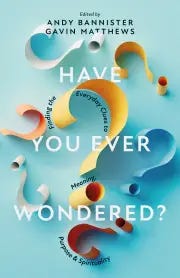
This essay was originally published as a chapter in the book Have You Ever Wondered: Finding the Everyday Clues to Meaning, Purpose & Spirituality. If you’re curious about faith, God, and Jesus—or have friends who are—it’s a gentle, warm, and engaging book for seekers and searchers. Find out more about it here—or read on to find how to get the ebook version as a gift from me.
If you found this piece helpful, thought-provoking, curiosity-sparking or in other ways useful, please do consider subscribing. It helps me keep my writing free for those who can’t afford to make a contribution.
And if you become a paid subscriber (or already are) and would like the ebook version of Have You Ever Wondered? as a gift, drop me a message in Substack and I’ll send you a copy as a thank you for financially supporting my work.
Stephen Marche, ‘Is Facebook Making Us Lonely?’, The Atlantic, May 2012.
Cited in Paul Duncan, Stanley Kubrick: The Complete Films (Taschen, 2011), p.9.
Cited in Walter Hooper, C. S. Lewis: The Companion and Guide (HarperCollins, 2005) p. 177.