


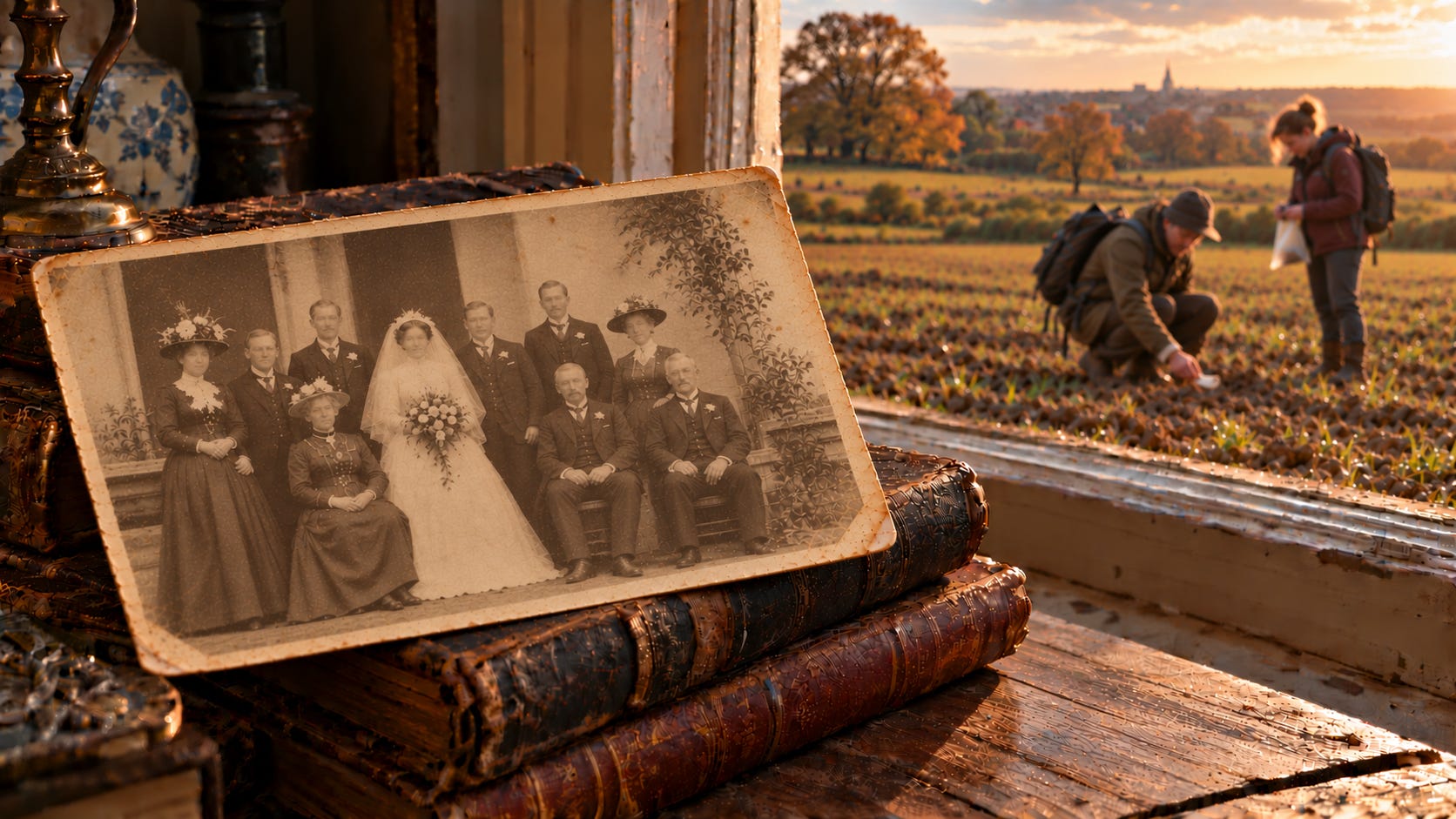
During the Covid pandemic a few years back, my daughter Caitriona fell in love with archaeology. More specifically with fieldwalking, the archaeological method which consists of simply pacing across a ploughed field and seeing what you find. Stuck in lockdown as we were, the field behind our house in Scotland became a regular stamping ground and every time we went for a walk, Caitriona would find bits of old pot, broken clay pipes, the occasional Victorian coin and so on.
Before long, Caitriona had amassed vast amounts of the stuff and, alas, despite our offers to deliver it in person, the British Museum haven’t yet offered to name a gallery after her. (Although I’m also tempted to write to NASA and say if they’re still worried about the missing dark matter in the universe, I think most of it is in plastic tubs in my daughter’s wardrobe).
On one occasion a friend of my daughter’s, Alice, was visiting and Caitriona showed her some of her favourite finds from her extensive collection. “What’s so exciting?” asked Alice, sniffily, “it’s just rotten stuff from dead people. Here, have you seen this cool new game on my phone?”
Thankfully we’ve raised a teenager who thinks phones are really boring and is more interested in clay tablets than digital ones. So my daughter was a bit put out that her friend had the historical consciousness of a whelk.
To be fair, Alice isn’t alone, for as a culture we have a very strange relationship with history, not least because our obsession with our smartphones means we spend most of our time living in a continually rolling window of ‘now’, with most of us less aware of the story that’s come before us than many other cultures, or indeed people in our own culture would once have been.
In the modern west, our approach to history seems to consist of monetizing it (Hollywood, I’m looking at you); gawping at it in museums (and getting embarrassed when we get old enough for bits of our own childhood to show up in glass cases); atomizing it (I love the British Museum, but get really frustrated there’s no attempt to explain how the different eras fit together); or cancelling bits of it.
The last one is a particularly peculiar obsession of our age not least because we are wildly inconsistent—pulling down the statues of people (like Edward Colston, chucked into Bristol harbour in 2020) whilst naming airports after people like John Lennon, who admitted he hit women.1 I’m also struck that other cultures seem entirely unashamed of their own mixed pasts. A friend of mine recently went to a Mongolian Throat Singing concert (yes, really) where he said that 90% of the songs were about the glories of Genghis Khan’s battles!
And if we’re not doing those things, others of us are tempted to romanticize the past—conjuring up how wonderful it was before (insert whatever you don’t like, whether technology, our current vacuous political class, general ignorance, the collapse of public morality, or the invention of fidget spinners).
There has to be a better way to think about history. Because all of those modern approaches to history suffer from the same basic flaw: they don’t ever stop and properly listen to history. If we slow down and do that then maybe, just maybe, we might learn something from history. (And by the way, if you’re tempted, like Alice, to say “Bah! Dead people!” well that’s just chronological snobbery. And just as you wouldn’t say of another culture “What can we possibly learn from them?” it’s as bad to dismissively sneer “What can we possibly learn from the seventeenth century?”)
And that the past might offer us something, might be a source to learn from, a different perspective from outside of our bubble, brings me by a long and winding road to why I love reading old books and the author I read more than any other is F. W. Boreham.
Born in 1874 in Tunbridge Wells, Kent, Boreham emigrated to New Zealand after training at Spurgeon’s College and proceeded to pastor in New Zealand, then Tasmania, then Melbourne in mainland Australia, before launching into a more itinerant preaching career in his 50s. In each pastorate, he showed not just a gift for preaching but also for evangelism, engaging those who had turned their backs on Christianity. He took their questions seriously, crafted messages that engaged them, and saw each church he led grow tremendously.
But Boreham also had a growing gift for writing. On occasion, after missing a train connection and finding himself with some time to kill, he noticed the lights on late in the local newspaper office. He wandered in, introduced himself to the editor, and asked whether the paper had considered a Christian column. The editor pointed at a typewriter and challenged Boreham to have a go.2 The piece he hammered out was in the next day’s paper and was the first of thousands of columns Boreham would write throughout his life.
As Boreham’s writing skills matured, he was soon writing three or four devotional and evangelistic essays a week—these ended up being collected and published as a series of over fifty books which found a worldwide audience. It’s hard to calculate the numbers as some records have been lost—and Boreham was famously modest—but a friend of mine who is a Boreham scholar estimates several million copies of Boreham’s books have been sold.
I’ve been collecting and reading Boreham for ten years now and I love the way he builds illustrations in each essay. He will take an everyday item—whether something grand (a mountain view) or mundane (a used envelope)—and build a story around it that points to some deeper, Christian truth.
One of my favourite Boreham essays is ‘A Slice of Infinity’, found in his book Mushrooms on the Moor.3 In it, Boreham comments on how easy it is to get stuck in a rut of reading very narrowly—telling the story of how, whenever he stepped through the door of his local bookshop, the bookseller would recommend books on topics very similar to those Boreham had bought before. (In today’s age, Amazon’s algorithms can send us into similar cul-de-sacs). But, says Boreham, we should resist such temptations at all costs—instead we should aim to sample ‘a slice of infinity’ in our reading.
But why? Because reading widely not merely helps broaden our thinking, it also helps us connect. If you find yourself seated on a plane next to somebody who says their hobby is angling, you’ll be glad you picked up a second-hand copy of Fly Fishing by J. R. Hartley. At the time I read ‘A Slice of Infinity’, I had slipped into a bit of a rut in my reading, so Boreham helped kick me out of it—not just in the authors I read, but in what I read of those authors. He encouraged me, for example, to read C. S. Lewis more widely, not just Lewis’s fiction, but also his essays.
And in one of Lewis’s essays, he also says something about reading widely—not just across subjects but also across centuries:
Every age has its own outlook. It is specially good at seeing certain truths and specially liable to make certain mistakes. We all, therefore, need the books that will correct the characteristic mistakes of our own period. And that means the old books.
All contemporary writers share to some extent the contemporary outlook—even those, like myself, who seem most opposed to it. Nothing strikes me more when I read the controversies of past ages than the fact that both sides were usually assuming without question a good deal which we should now absolutely deny …
We may be sure that the characteristic blindness of the twentieth century—the blindness about which posterity will ask, “But how could they have thought that?”—lies where we have never suspected it ... None of us can fully escape this blindness, but we shall certainly increase it, and weaken our guard against it, if we read only modern books. Where they are true they will give us truths which we half knew already. Where they are false they will aggravate the error with which we are already dangerously ill.
The only palliative is to keep the clean sea breeze of the centuries blowing through our minds, and this can be done only by reading old books. Not, of course, that there is any magic about the past. People were no cleverer then than they are now; they made as many mistakes as we. But not the same mistakes. They will not flatter us in the errors we are already committing; and their own errors, being now open and palpable, will not endanger us. Two heads are better than one, not because either is infallible, but because they are unlikely to go wrong in the same direction.4
But there’s a final reason to take history seriously and that’s because one day we will be history. It’s an uncomfortable thought, but one day we will be as done-and-dusted, dead-and-gone as the ancient Greeks, Romans, Anglo-Saxons, the Victorians, you name it. And if this life is all there is, that raises the question: why should anyone care about us and our story? Indeed, why should we care about the past—why treat some ancient bones dug up by an archaeologist with respect, if it’s just rotten stuff from dead people?
It’s sobering, too, to realise we will be forgotten and sooner than we realise. Think about this: do you know the names of your great grandparents? Or your great-great grandparents? Probably not. I was reminded of this recently when I noticed an old photo from the late 1800s my mother had framed and put on her wall. It showed a group of ten people, wearing their best clothes—perhaps a wedding party. I asked my mother who the people were and she said “I know the names of two of them, but not the others”.
That’s likely to be our fate, too. Gone and forgotten. Which raises a problem because I think a good principle is that we should treat the past as we hope the future will treat us. I suspect we hope the future will be kind to us, remembering our successes, treating us gently where we judged things wrong. But if we ourselves haven’t done this to the past, why should the future do it to us—or indeed bother to remember us at all?
Well, “do unto the past as we would like the future to do unto us” sounds similar to something Jesus once said about how we should treat other people. And mention of Jesus is interesting because when it comes to history, Christianity has a unique relationship with the past, especially in the way it is grounded in history. For example, if Buddha or Muhammad had never been born, if they’d never existed, their teaching could (hypothetically) still be true as it’s largely timeless and rootless. But if Jesus didn’t die and rise sometime around AD 33, then the whole thing falls, for Christianity isn’t a set of teachings brought by Jesus, Christianity is Jesus. As the apostle Paul writes:
If Christ has not been raised, our preaching is useless and so is your faith. ... For if the dead are not raised, then Christ has not been raised either. And if Christ has not been raised, your faith is futile; you are still in your sins. Then those also who have fallen asleep in Christ are lost. If only for this life we have hope in Christ, we are of all people most to be pitied.5
And if what Jesus did in history is true, that means we have a future. Because we won’t be forgotten: we are remembered by the one who matters, the one who calls us into his eternal future. The names of those faces in the photo on my mother’s wall may have been all but forgotten by us—but all ten of them are known to Jesus.
David Barnett, ‘How John Lennon was made into a myth’, BBC Culture, 8 December 2020, www.bbc.co.uk/culture/article/20201207-how-john-lennon-was-made-into-a-myth.
See F. W. Boreham, My Pilgrimage. London: The Epworth Press, 1949 [1940]) pp. 190-200 and T. Howard Crago, The Story of F. W. Boreham (London: Marshall, Morgan & Scott, 1961) pp. 92-93.
F. W. Boreham, ‘A Slice of Infinity’ in Mushrooms on the Moor (London: Epworth Press, 1928 [1915]) pp. 11-20)
C. S. Lewis, ‘On the Reading of Old Books’ in God in the Dock: Essays on Theology and Ethics (Grand Rapids: Eerdmans, 1970).
1 Corinthians 15:14, 16-19.