


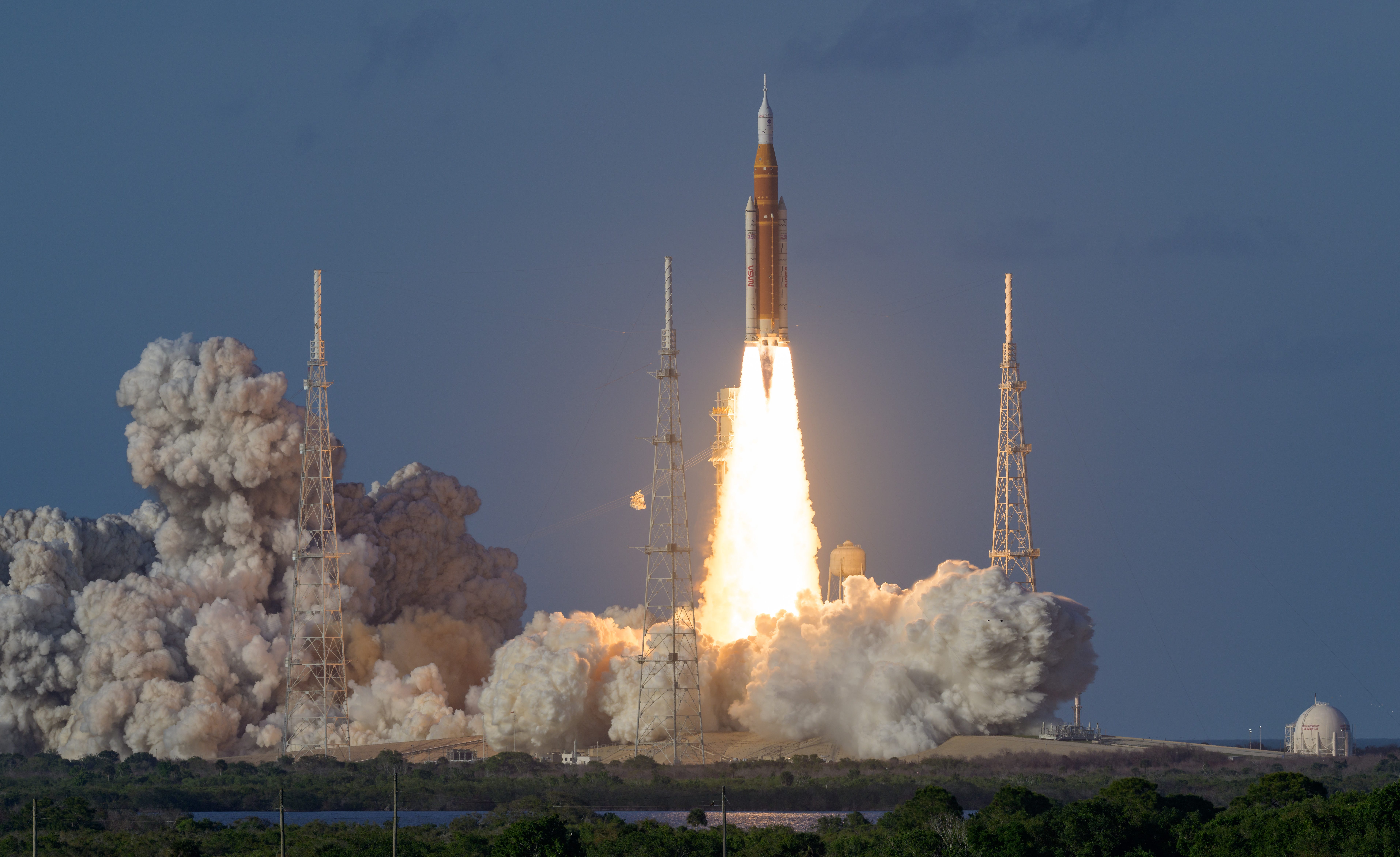
Like millions of people, I spent much of the first ten days of April glued to a screen, watching the various NASA live streams of the Artemis II mission. As a science nerd who was born in 1972—the year human beings last walked on the Moon—watching humanity’s latest push for the stars streamed in HD was almost too exciting for words.
But not everybody was impressed. I don’t just mean the Flat Earth Society (whose horizons are naturally somewhat limited) but also journalist Zoe Williams, a columnist for The Guardian newspaper, who grumbled:
We’re wasting all this energy, time, technology and thought going somewhere where there’s nothing alive.1
Aside from the fact that, taken to extremes, Zoe’s reductionism would rule out investing in art galleries and libraries, studying archaeology, or visiting Bognor Regis in February, it also ignores the fact that exploring extreme places sfeems to be a crucial part of being human.
I’ve long been fascinated by the epic periods of polar and Himalayan adventure and I have metres of shelves of books detailing the exploits of Scott and Amundsen as they sought to conquer the poles (my wife’s great-great-grandfather certified Amundsen’s ship, The Fram), or the incredibly exciting attempts to climb Everest in the 1920s, a struggle in which the mountaineers George Mallory and Andrew Irvine lost their lives. It was Mallory who, in an interview with The New York Times, when asked “Why climb Everest?”, famously replied:
Because it’s there.2

I think Mallory was onto something. As human beings we have this drive, this urge to explore that we simply cannot ignore. Be it the top of the highest mountain, the bottom of the deepest ocean trench, or the dark side of the Moon—or even further beyond, whether it’s colonising Mars or sending probes beyond the solar system—there is something unique to our species that is wired to explore.
It seems that the Bible may have been onto something when the writer of Ecclesiastes penned these words:
God has set eternity in the human heart.3
This urge to explore is tough to explain in purely materialist terms. If humanity’s sole purpose is simply the same as every other species, mere survival and reproduction, then it’s hard to see what dying on Everest, or risking one’s life going to the Moon does for the overall fitness of the human race. On a Zoe Williams view of the world, far better to cancel NASA’s budget and use the money to solve the population crash: perhaps incentivise things by offering a free Lego model rocket as a gift for any family who pop out three or more kids.
But aside from what drives our need to explore, to enquire, to boldly go where nobody has gone before,4 as I watched the live feeds of the Artemis II mission this all raised another question: the sheer size of the universe. To quote science-fiction comedy writer Douglas Adams:
Space is big. Really big. You just won’t believe how vastly, hugely, mind-bogglingly big it is. I mean, you may think it’s a long way down the road to the chemist’s, but that’s just peanuts to space.5
When astronauts Reid Wiseman, Victor Glover, Christina Koch, and Jeremy Hansen splashed down into the Pacific Ocean on 10 April, they had flown 694,481 miles and set a new record for the furthest distance from Earth any human had ever been—some 252,757 miles away from home. That is indeed a very long way (considerably further than a trip to the chemist’s) but even that distance is a mere packet of mixed nuts compared to space. The Artemis II astronauts had travelled just 0.18% of the distance from the Earth to Mars and at the speed they flew, if they’d decided to take in a visit to Alpha Centauri (our nearest neighbouring star system) whilst they were at it, that would have taken them 120,000 years.
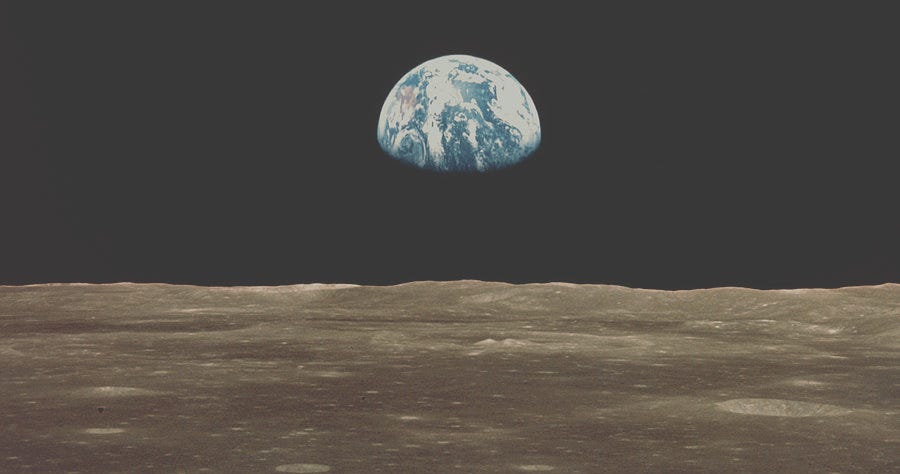
Space is really big. And by contrast, the Earth is really, really small, just a “tiny pea” as Neil Armstrong described it when he saw it from the Moon on the Apollo 11 mission. So what does that say about humanity and our place in the universe? After all, in purely physical terms, we are just a rounding error.
Consider some geeky maths for a moment. It is generally accepted that the known universe contains 1 × 10⁸⁰ atoms. Meanwhile, the average human being contains 7 × 10²⁷ atoms and there are approximately 8 billion humans alive today (8 × 10⁹). Multiply those two numbers together and we get the total number of atoms in all humans: roughly 5.6 × 10³⁷. That means that the percentage of all atoms that are currently busying themselves forming part of a human being is 5.6 × 10⁻⁴¹%. That makes us (in material terms) laughably insignificant.
So is humanity utterly and entirely cosmically pointless? On a purely material view of the universe, it’s hard to answer anything other than “yes” to that question. We can orbit around the Moon until we’re dizzy, we can stand on Everest on our heads, write a million novels, compose a myriad symphonies, discover the cure for cancer, the common cold, and folk music appreciation, but we still can’t avoid the resounding thud of the words as they spell out our doom: Humans. Don’t. Matter.
There’s no escape.
If we are only matter we don’t matter.
But what if we’re not just matter?
If the Christian story is true, then not merely does that explain where our urge to explore comes from, but it also tells us that we are not just an infinitesimal bit of cosmic dust in a cosmos that hasn’t even noticed we exist, but we are fashioned by the same creator God who flung the stars into space. A God who, when he made us, didn’t merely create us as one more life form, but breathed his Spirit into us and made us in his image.6 And from that image of God in us comes the unique human desire to learn, to create, and to explore.
If there is a designer behind the universe, then its sheer size isn’t a problem, because our value doesn’t come from our size relative to the cosmos, but from the purpose behind that cosmos.
A few years ago I had the thrill of doing a tour of Johnson Space Center (JSC) in Houston. I was staying with a friend whose wife was, literally, a rocket scientist and was working on the flight control software for the Orion spacecraft that flew atop the Artemis rocket. So I got to see not just the public areas at JSC, but some really neat behind-the-scenes stuff too.
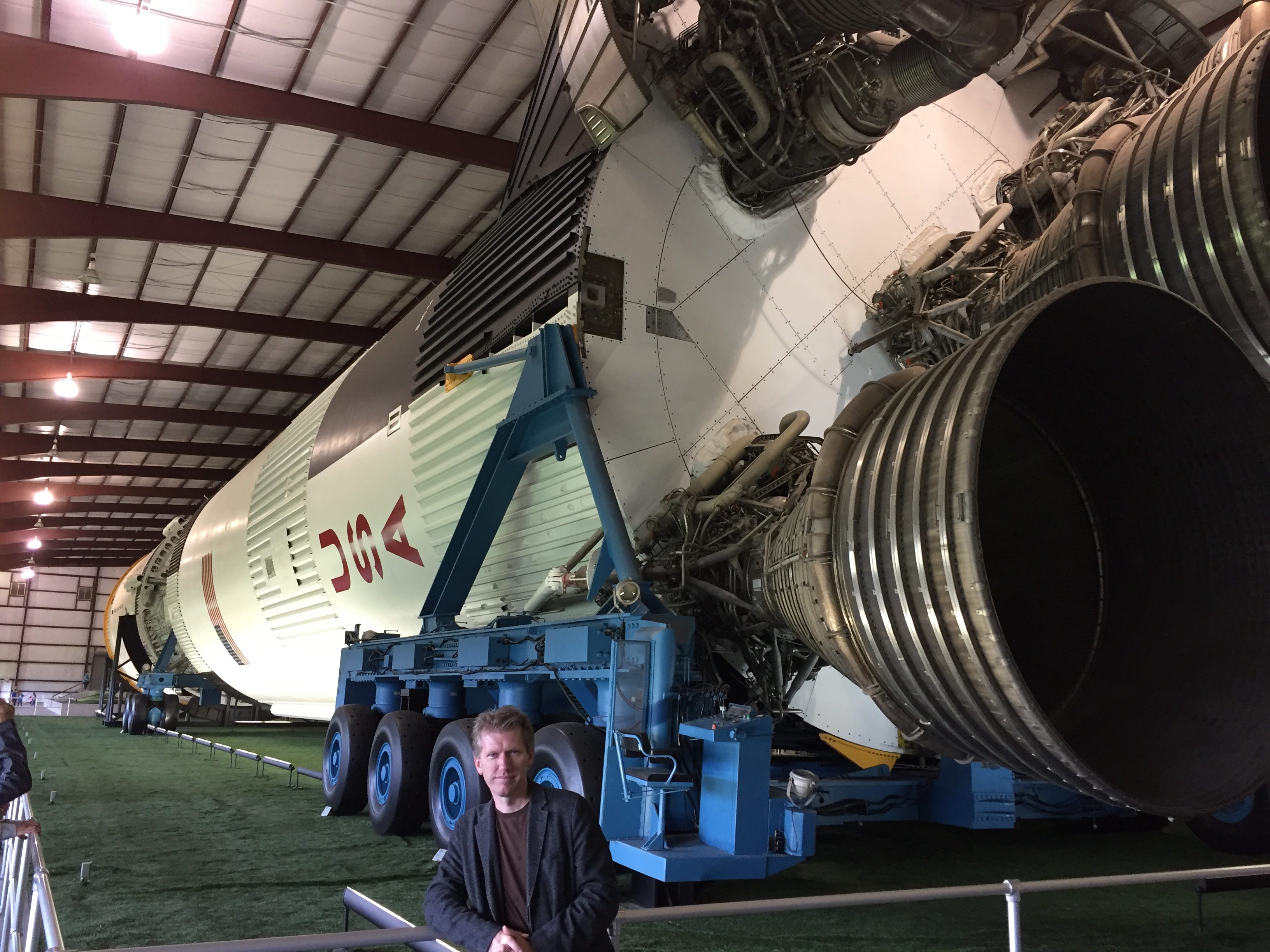
By far the coolest thing I saw was a Saturn V rocket. This was the machine that carried the Apollo space vehicles, most famously Apollo 11, in which Neil Armstrong, Buzz Aldrin, and Michael Collins flew to the Moon in July 1969. To describe the rocket as huge would be an understatement; a bit like saying “a blue whale is larger than a duck”. It’s technically correct, but lacks a certain something.
The Saturn V was a gigantic machine. Laid out on its side in a huge shed it stretched 363 feet from end to end, each exhaust nozzle alone stood 12 feet high (that’s over twice my height). All that engineering, all that technology, all the billions of dollars and years of human brilliance that had gone into making it were plain to see. And all for what? For three tiny little people, sitting in the Command Module at the top of the rocket.
A sceptic might look at all this and say, “Nah, that can’t be right; humans can’t be important in this mission. After all, the Saturn V weighed 6.2 million pounds and the three humans were just 0.01% of that mass. No, I’m not buying it”. But of course, the sceptic would have missed something crucial: the importance of the human beings in a Saturn V launch wasn’t the fraction they made up of the whole—by that measure, they were indeed tiny. But that smallness didn’t stop Armstrong, Aldrin, and Collins being the whole point of the adventure: the “one giant step for humanity” the whole endeavour represented.
Human beings are indeed, compared to the immensity of the universe, infinitesimally small. And we do indeed live on a pale blue dot. If atheism is true, then that’s the beginning, middle, and end of the story. We matter not one bit and one day, that pale blue dot will be swallowed by our Sun when it eventually dies, expands into a red giant, and engulfs the entire solar system in a fiery maelstrom of destruction.
If that’s what you believe we are destined for, then it’s hard to avoid the conclusion that the only way to live here and now is either sheer nihilism or utter denial: putting our fingers in our ears and refusing to listen to the raging silence of the void.
But if Christianity is true … well then, God has set eternity in the hearts of men and women, not just for now, but forever, as he has destined us not just for the Moon, not for Mars, not even for the galaxy, but for something even greater still.
If you found this piece inspiring, helpful, thought-provoking, curiosity-sparking or in other ways useful, please consider subscribing. It helps me keep my writing free for those who can’t afford to make a contribution. Thank you!
Zoe made the comments on ‘The Wrap’ on Sky News on 4 April 2026; you can watch the interview on X.
‘Climbing Mount Everest is Work for Supermen’, The New York Times, 18 March 1923 (Available online at www.nytimes.com/1923/03/18/archives/climbing-mount-everest-is-work-for-supermen-a-member-of-former.html).
Which is also the answer to the question: “Where did Neil Armstrong go to the loo on the Moon?”
Douglas Adams, The Hitchhiker’s Guide to the Galaxy (London: Pan Books, 1979), chapter 8.